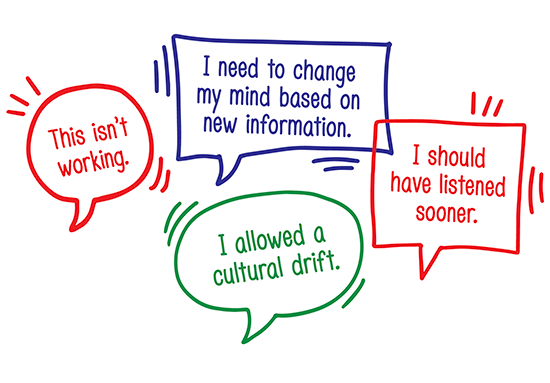
The column "Leadership Whiteboard" provides a short visual leadership coaching moment. It introduces and explains a new sketch in each issue, provides leadership coaching for further development, and shares a leadership quote and recommended book.
Leadership Whiteboard | Phrases Leaders Struggle to Say, Part 3
The first two installments of “Phrases Leaders Struggle to Say” explored courage and integrity then capacity and pace. This third column turns to another leadership challenge that quietly reshapes organizations: course correction. Vision rarely collapses in a dramatic moment. Direction erodes when leaders hesitate to acknowledge what no longer works, resist new information, or ignore the slow drift of culture.
Few phrases weigh on a leader more than, “This isn’t working.” Leaders invest time, resources, and credibility into initiatives, which makes admitting poor results difficult. Many “double down,” throwing more people, money, and effort into struggling programs. Stewardship requires the courage to say, “We need to stop doing this.”
Scripture does seem to offer a sobering counter-argument. The prophet Jeremiah faithfully delivered God’s message for decades with little visible success. However, Jeremiah’s faithfulness rested in obedience to the message, not in defending ineffective methods. His example does not grant modern leaders permission to cling to familiar approaches when results disappear. Faithfulness and fruitfulness both deserve attention. Leaders who refuse to evaluate methods eventually exhaust their people, stall progress, and lose credibility.
Another phrase leaders struggle to say is, “I need to change my mind based on new information.” Leaders sometimes assume consistency proves strength. However, stubbornness usually reveals insecurity. New data, fresh insights, and different perspectives often come from people who possess knowledge or experience the leader does not have. Healthy leadership welcomes that reality.
Presidents assemble cabinets for this very reason. Advisors bring expertise, perspective, and relationships one person alone cannot possess. Titles carry influence, yet ignoring wisdom around you eventually erodes credibility. Leadership never requires the leader to be the smartest person in the room. Leadership requires the wisdom to listen when someone else offers better information.
Admitting “I allowed a cultural drift” may be the most uncomfortable phrase of the three. Culture rarely collapses overnight. It slides through small compromises and unchallenged behaviors. Expectations and priorities soften or blur. Values that once defined the organization become slogans instead of convictions. Drift usually reflects what leaders tolerated more than intended. Naming drift restores clarity. Leaders shape culture through what they reinforce, what they ignore, and what they correct.
The final phrase carries quiet humility: “I should have listened sooner.” Leaders often receive signals long before problems surface publicly. Team members raise concerns. Data hints at warning signs. Feedback appears in conversations that feel easy to dismiss in the moment. Listening earlier saves the organization from painful correction later.
These phrases share a common responsibility: leadership requires the courage to correct course. Leaders who refuse to evaluate programs protect tradition rather than mission. Leaders who reject new information limit growth. Leaders who ignore cultural drift weaken shared values. Leaders who delay listening invite unnecessary consequences.
Course correction rarely feels comfortable, yet clarity always strengthens the path forward. When did you last evaluate your direction?